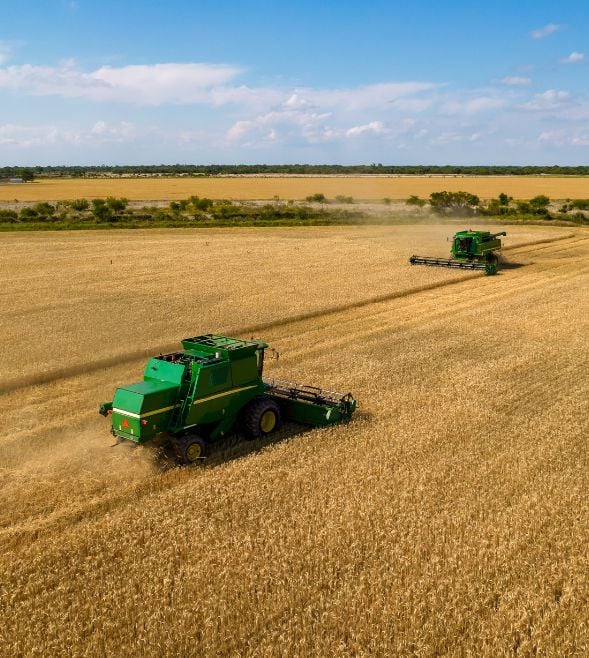
Its location, connectivity, infrastructure, industry and human capital make it a fundamental pillar for the development of the region and the country. In 2024, Santa Fe’s Gross Geographic Product (GGP) grew by 4.1% year‑on‑year, driven by a 14.4% expansion in goods‑producing sectors. Agriculture, livestock, hunting and forestry, together with manufacturing industry, showed the strongest performance (57.9% and 4.5%, respectively) and made the largest contributions to the growth rate (5.33% and 1.16%, respectively).
 The province’s share of national Gross Value Added (GVA) reached 10.1%, increasing its weight in the country’s economy. “Over the past 30 years, the highest participation was recorded in 2020, with a share of 10.7%. This indicates that Santa Fe still has room to grow. In addition, according to the latest available data, in 2023 it contributed 7.8% to national GDP,” explains Fernando Fucci, Managing Partner of Grant Thornton Argentina.
Located in the Central‑Eastern region of Argentina, Santa Fe holds a strategic position for domestic and international trade. It is the central axis of the Paraná–Paraguay Waterway, representing one third of its total length, and serves as the gateway for 75% of the country’s cereal and oilseed exports. In 2019, the main destinations for products originating in Santa Fe were China (10.4%), India (8%), Brazil (7.8%), Vietnam (5.9%) and Indonesia (5.1%).
Annual exports originating from the Province of Santa Fe
Source: Rosario Stock Exchange based on IPEC.
The province’s economic structure is one of the most diversified in the country. Santa Fe has successfully leveraged the advantages of its soil and location to develop multiple industries and supply many others. At the same time, it has evolved alongside technological advances, promoting research, development and innovation projects.
Activity
 “Its diversity of climates and soils enables the development of forestry, agricultural, mining, energy‑generation and industrial activities, and the province is a pioneer in scientific and technological development across the different stages of production,” notes Leonardo Fraga, lead Audit Partner at Grant Thornton Argentina. “In addition, its productive fabric is made up of cooperatives and mutual associations, as well as SMEs and large national and multinational companies.”
Agriculture
The province forms part of the Pampeana region and, in its northern area, the Chaqueña region. Its plains benefit from an extensive hydrological network and a diverse climate, making it fertile ground for a wide variety of crops depending on the area.
 Agricultural production in Santa Fe is among the most significant in the country, standing out mainly for extensive crops such as soybeans, maize and wheat. “Over the past 20 years, there have been profound changes in both structure and volume,” explains Julia Adano, lead Tax Partner at Grant Thornton Argentina and agribusiness spokesperson. “One of the most significant changes was the expansion of soybeans, driven by the adoption of new technologies such as no‑till farming and genetically modified seeds.”
The planted area of each crop varies year by year, as producers adjust their planting decisions according to prevailing climatic and economic conditions. Nevertheless, soybeans have remained the dominant crop since the late 1980s, and in the 2019–2020 season, 4.9 million tonnes were harvested in the central‑northern region of the province, with an average yield of 34.7 quintals per hectare—one of the highest on record.
In the 2024/25 season, the province reached the largest planted area in its history (6.32 million hectares), expanding by 240,000 hectares compared with the previous cycle. Soybeans led this expansion, followed by wheat, sunflower, sorghum, cotton, barley and rice. Maize planting declined due to the presence of the leafhopper pest, particularly in the north of the province.
In the north, cotton has expanded significantly over the past 15 years, and exports show an upward trend. “In the latest season, around 230,000 hectares were planted, representing 30% of the total area in the country, and the major opportunity lies in value added,” explains Adano. “Installed capacity for yarn, oil, cellulose and absorbent cotton production does not cover the supply of raw material, which is therefore sent to other provinces for processing.”
Livestock and dairy farming
As of 31 December 2025, 11.6% of the country’s livestock stock was recorded in the province of Santa Fe, which holds the second‑largest number of cattle and slaughtering volumes (17% of the national total). Regarding dairy cows, as of March 2026, 32.1% of the total were distributed across more than 3,000 dairy farms in the province, representing a 34.9% national share.
The February 2026 report by the Observatorio de la Cadena Láctea Argentina (OCLA - Argentine Dairy Chain Observatory) indicates that 29.2% of milk production originates from the Santa Fe dairy basin, making it one of the most important in Argentina and Latin America. In addition, at an industrial level, the province hosts the main processors and exporters, as well as a large number of SMEs that supply the domestic market and energise the regional economy.
Beekeeping
Alongside agriculture and its biomes, beekeeping is carried out throughout the provincial territory. Floral diversity, good practices and applied technology make it possible to produce high‑quality honey for export markets. In 2019, through Law No. 13,870 for the Promotion, Protection and Development of Beekeeping Activity in Santa Fe province, the development of beekeeping was declared to be of provincial interest as an essential economic, agro‑industrial and productive activity.
“In Argentina, 90% of honey production is destined for foreign markets,” notes Adano. “Santa Fe is one of the main producing provinces and accounts for 15% of the national total.”
Aquaculture
The eastern part of the province receives the waters of the Paraná River and offers extensive natural conditions for the development of aquaculture. The provincial government has implemented a fisheries programme by creating a scientific hatchery and demonstration units to promote the production of freshwater fish, expand genetic diversity among different species, and generate scientific and technological experimentation.
“Aquaculture is a sustainable alternative to extractive fishing. Worldwide, more than half of the fish consumed comes from aquaculture, and Argentina has expanded the farming of bogas, carps, dorados, oysters, pacú, frogs and surubí, substituting imports,” reveals Adano. “In Santa Fe, freshwater species such as pacú, sábalo and silverside can thrive both in ponds and in cages in open waters, representing a major opportunity for investment and growth in the province.”
Mining
 In recent years, Santa Fe has strengthened its position as a strategic supplier to the mining‑energy industry. “Along the banks of the Paraná River there are several silica sand quarries, which is a third‑category mineral and can be used for construction, the glass and foundry industries, as well as in the oil industry for unconventional gas and oil extraction thanks to its high purity and granulometry,” explains Estanislao de León, Audit Partner at Grant Thornton Argentina and Energy and Natural Resources spokesperson.
“Silica sand is a critical input for hydraulic fracturing (fracking), the technique used in Vaca Muerta for shale extraction, where a single well may require between 10,000 and 15,000 tonnes,” he adds. “Although road transport represents the main limitation due to logistics costs and the distance from Patagonian hydrocarbon basins, the Paraná waterway can be leveraged.”
Likewise, Santa Fe plays a central role as an industrial and metal‑mechanical supplier. The province hosts a network of companies that manufacture capital goods, components, equipment, metal structures, pumps, tanks and pipelines, and provide solutions to meet the needs of the mining, oil and gas sectors. “This network has a strong base of industrial SMEs and enables the coverage of a large portion of demand for non‑extractive inputs, reducing import costs and strengthening domestic content within the energy value chain,” reflects de León.
Energy transition
Santa Fe also makes a strategic contribution to the national energy matrix through production. The province is a leader in biofuels, having consolidated an industrial hub parallel to the oil‑crushing sector, with productive capacity exceeding 3.2 million tonnes per year and accounting for around 80% of the country’s installed biodiesel capacity.
 “The country’s potential in the biofuel industry is comparable to that of Vaca Muerta, and Santa Fe is at its heart,” says Gabriel Righini, Audit Partner at Grant Thornton Argentina and Energy and Natural Resources spokesperson. “The province has 16 authorised plants out of 33 nationwide and a production capacity close to 3.2 million tonnes per year.”
Biodiesel production generates by‑products that add value to multiple industries, such as agriculture and pharmaceuticals. “The main by‑product is crude glycerine or glycerol, which once refined is used in the pharmaceutical and cosmetic industries. Oilseed residues and the resulting meal are also high‑protein feed for livestock,” explains Righini.
Santa Fe’s advantage lies in the possibility for companies to vertically integrate production: planting, harvesting, storage and grain crushing for oil extraction and biodiesel production. In addition, the biofuels industry in Argentina has an export‑oriented profile, and proximity to the Port of Rosario benefits companies based in Santa Fe.
Science, technology and innovation
Santa Fe has consolidated itself as one of the main knowledge‑economy hubs in the interior of the country, thanks to its solid base of highly qualified human capital, supported by its university, scientific and technological ecosystem. The province is home to leading national universities, CONICET institutes and technology centres. In 2021, Santa Fe directly exported USD$ 54,718,386 worth of biotechnological products to 84 countries across all five continents, with the main destinations being Brazil, Mexico and Chile.
Software, artificial intelligence, bioeconomy, industrial technology and biotechnology are among the areas in which companies in the sector operate. “A milestone in the local knowledge economy was the patenting of HB4 transgenic wheat in 2012,” highlights Fraga. “However, while agriculture and livestock are the major industries requiring innovation, the province’s capabilities also specialise in biotechnology for human health, including molecular diagnostics, bioinformatics, biomaterials, regenerative medicine and solutions for complex diseases.”
Promotion of industry
Santa Fe has enacted various regulations granting tax benefits to companies in the province. “Depending on income levels, industrial activity is exempt from the Turnover Tax, and companies engaged in industrial activity may apply for an Industrial Activity Certificate, which exempts them from Provincial Stamp Tax for one year,” explains Adano. “In addition, under Industrial Promotion Regime Law No. 8,478, industrial companies located in the province, or planning to establish there, may apply for exemption from provincial taxes for up to ten years.”
The provincial government also adheres to the National Knowledge Economy Promotion Regime and has its own benefits scheme—the Registro Provincial de Beneficiarios de la Economía del Conocimiento Provincial (REdC - Register of Knowledge Economy Beneficiaries)—under which registered companies enjoy tax stability and exemptions from turnover tax, stamp tax and property tax for ten years from the date of registration.
Opportunities
Overall, Santa Fe consolidates a development model based on the integration of primary production, industry, logistics, science and technology. Its diversified production network, capacity to add value at source, and strong export orientation allow the province to play a strategic role in the national and regional economy. Vertical integration across its value chains, the scale of its infrastructure and the quality of its human capital position Santa Fe as a key territory for enhancing the country’s competitiveness in an increasingly challenging global context.
With active promotion policies and an ecosystem that combines productive tradition with innovation, Santa Fe displays strong potential to continue growing and attracting investment. Strengthening strategic sectors such as agribusiness, energy, the bioeconomy and the knowledge economy reinforces its profile as a driver of Argentine development, with the capacity not only to sustain its historical leadership but also to project itself as a leading player in the productive transformation of the years ahead.